Monday, March 26, 2007


Second warm day in a row, and locals are admiring and photographing the blossoms on Chang'An Jie, as you drive past Tiananmen Square.

Had another fight withe the bao an, this time the security guard at the diplomatic compound just next door to mine, when they demanded my passport, but not the passport of any other foreigners entering. The guy actually chest butted me. I was so shengqi.

Last week was the on-again, off-again six party talks. They're off again.

Have been writing about soccer stars and petitioners, and how for migrant workers, Chinese New Year isn't always the family-centric holiday it seems.


Only one of their five children made it home to see Zhi Jifang and her husband, Huang Peibing, in Yanyan village, Henan province, for Chinese New Year. Abnother said maybe. The couple used to look after four grandchildren but now only care for one. Their own children are busy doing migrant work in faraway cities and family ties are strained.


Lui Huana, rear, in white shorts, practicing in Kunming, Yunnan province, with the rest of China's national womens soccer team. Couldn't get any closer.

Thursday, March 08, 2007


The tenth National People's Congress is on, through March 16th. China's Foreign Minister used the occasion to host an annual press conference Tuesday at which he urged Japan to face historical facts but otherwise took the let's-uphold-friendly-relations route. Today, leaders debated a controversial law to help protect private property, which experts say is likely to pass.

These pictures don't have anything to do with China, but last week I was skiing in France with family and friends. It snowed nearly everyday, which meant zero visibility but terrific powder conditions. I took these photos on our one full day of sunshine. Breathing clean mountain air was great. Within 12 hours of being back in Beijing, I'm clearing my throat again. I'll spare you any more detail, but for those unused to it, the pollution here is not just a news headline.


Wednesday, March 07, 2007


Duck eggs at Mengyang market, outside of Jinghong city, in the XiShuangBanna region of southern Yunnan Province. Bordering Laos and Burma, near Thailand, this region is much more relaxed and laid back than the rest of China. The women wear heels and beautiful silks even when working the fields and markets.

Not so long ago, before China's opening and reform first kicked off in about 1978, free enterprise was so thoroughly reviled that even peasants selling fresh eggs were criticized as capitalists. The editors asked me to write about the topic here and here.

Meanwhile, am getting both encouraging and hostile email over a recent story about gays and lesbians in China. Some appreciative readers say they had no idea it was legal to be gay in China. Another thought it was a crime to run a photo of a drag queen. We did so because a few years ago there were almost no gay bars at all, and now in Beijing alone there are dozens, with drag queens and with advertisements in local magazines. And yet there is still a lot of stigma and misunderstanding, including psychologists who advertize what they say are cures for gayness.

Saturday, February 17, 2007


Fireworks have been going off all night, but they intensified half an hour ago, at midnight Saturday, or New Year's Eve according to the Lunar calendar. You could see them in three directions, from a dozen different locations just from my apartment windows. Gong Xi Fa Cai, or Chun Jie Kuai Le, everyone has been saying. The nightsky is cloudy with smoke, and I can't take any decent pictures.

Spent a long weekend in Bangkok last week with friends who crammed in everything possible in three days: pomelo salad with tamarind, shrimp cakes, sea crab with yellow curry, mango and sticky rice. In the markets, there were laquered bowls made of eggshells, turquoise rings from Afghanistan, sieves made from pierced coconut shells and amulets of all kinds to ward off bad spirits and bring job success. Above, photos of Thailand on sale on the street near the Jim Thompson House.


Vendor wrapping betel nuts, which are palm nuts from the areca tree, believed by some locals to cure headache, fever, even venereal disease. The leaves are apparently mildly intoxicating, especially with lime paste.


Mango and sticky rice: amazing. The mangoes here are unlike any I've had elsewhere. Intense flavor, ever ripe, never stringy.


Purple crabs for sale on the street - in plastic bags.


The Reclining Buddha at Wat Pho, Bangkok's largest and oldest temple.


Resin Buddhas and resin Buddhas coated with silver, at the amulet market.

Tuesday, February 13, 2007


This electronics company two hours west of Shanghai recently fired 22 people who are carriers for the Hepatitis B virus (which is transmitted by blood, maternal-infant transmission or through sex rather than casual contact). The company, which employees say makes up to a million all-in-one printers for Hewlett Packard every month, says it didn't discriminate: it was just protecting the health interests of the other 6,000 employees.

Monday, February 05, 2007


It's hard to get a real sense of Wanlong ski resort from these photos, but it's not bad skiing (trail map here) considering the other choices currently available in China. Colleagues, as well as the bulletin boards at that's Beijing have reported big crowds, bad lines, dangerous beginners and tiny bunny hills elsewhere. Nan Shan is said to have a good snowboard park, and a problematic lift at Shi Jing Long supposedly stranded passengers for two hours. Wanlong has a combination of natural and man-made snow, is decently groomed, operates about four lifts, six runs. Not particularly difficult, but enough skiing to make you sore. One local did crash into one of our group, sending him flying. The local kept going.

It's a 3-1/2 hour bus ride north of Beijing, in industrial Zhangjiakou, Hebei province. There are $67 suites that sleep four in a comfy hotel at the foot of the chairlifts. A day and a half lift pass is about $38 if you have your own equipment, about $64 if you need to rent: quite expensive by Chinese standards. Not only did Wanlong rent parabolic Salomon skis, but many of the Chinese customers were kitted out in the latest brand name helmets and ski gear. Customer service was better than in Beijing's five star hotels.

Nearby work has begin on another resort called Saibei Dolomiti Ski, a joint venture between the Chongli county government and a private company that seems to be comprised of Italian and German investors. It's about three or four square miles, and will be five times as a big in a few years. At the moment, one trail, a mile long, is finished, and ski fans are blogging about trying it out possibly for free, before the coming Spring Festival. You'd have to stay in Chongli county or in a farmer's home because there's no hotel yet.


Friday, February 02, 2007


Lost in Translation

This photo was taken recently by Beijing hiker Raquel Martins, near the Shunyi residential neighborhood. Beijing registered a record 22,079 new motor vehicles in the first 18 days of 2007, the New China News Agency reported last month. That's more than 1,226 new cars on the road each day. By May, there will be more than three million cars in this city of 13 million people, officials said.
Why overstuffed news bureaus in China blackmail sources, and why the tradition of hong bao (cash-filled red envelopes) is likely to continue, covered by my colleague here and here and posted on China Digital Times by Newsweek's Jonathan Ansfield here.

It's not just the practice in China, but also in Taiwan (scroll to reader comment from 11/4/06). It's not just among journalists but also local officials.

Monday, January 29, 2007


Jade statues, paintings and calligraphy scrolls and other treasures confiscated from corrupt officials went on auction today in Hefei, Anhui province. There is a photo here, which says the items were taken from officials such as the former Anhui vice governor and the former mayor of Fuyang. Whether in a sign of curiousity about the scale of corruption or just continued passion for costly art, nearly 400 people attended (headlines about nabbed officials make for popular reading here). Some objects went for ten times over their original price. Virtually all the proceeds will go to the state treasury, state media said.

In November, an oil painting by Liu Xiaodong sold for a record-breaking $2.7 million. It's so big it's hard to take a picture of it. The painting depicts people displaced by the controversial Three Gorges Dam.

The buyer was Zhang Lan, the 48-year-old founder and chair of the Sichuan restaurant chain South Beauty, auction staff said. Zhang is worth a reported $125 million, tied with others at No. 21 on the Hurun List of the Richest Women in China. Maybe, art watchers say, she will display it in her new restaurant in New York City's Times Square, to be designed by Philippe Starck later this year.

"Unlike trading houses or playing the stock market, trading paintings makes more money and the risk is comparatively lower," said Yang Feixang, a slight man of 38 who has been active in the art market since he was 18. Now the owner of six art galleries in Changchun, in Northeast Jilin Province, Yang comes to Beijing art auctions at least twice a year.

Five years ago, he said, a painting by Fan Zeng, an art professor in Tianjin's Naikai University, was worth $1 million yuan or $128,200. Today, it is worth more than $1.9 million, he said. "But if you invested one million yuan on the stock market five years ago, it’s possible that now you get nothing.”

Sunday, January 28, 2007


Imported wine is the latest fad among middle class Chinese. A well-known Shanghai entrepreneur told the owner of the largest wine distributor in China: "Wine is a really good gift. I can give it to somebody, even a government official, and it's not perceived as a bribe."

But wine making here has a long way to go – a group of Australian wine experts recently toured the country's wineries and concluded they were better off selling bulk wine to China rather than investing in any local wineries. Bulk wine is shipped here, combined with other ingredients and then sold as Chinese bottled wine because there aren't yet enough grape for the Chinese to make their own.

Chinese consumers still drink less than a liter per head of wine each year, while the French drink more than 55 liters per head and Americans consume about 8 liters per head, experts say.

Above, corporate lawyer Yao Yi at a recent wine tasting in Beijing. Below, Robert Cho in the the wine cellar of his high-end restaurant Tiandi Yijia off Tiananmen Square.

Saturday, January 27, 2007


Online dating is big in Beijing, with many people saying they like being able to hide behind their computers until they "get to know someone." When online dating organizations host events for members to actually meet in the flesh, most participants are painfully shy. Emcees at this Love21cn.com event had to coax many of them onstage to sing or announce their online numbers so that interested partners can later email them. As opposed to going right up to them and saying hello, of course.

Meanwhile (i.e. totally unrelated), the Wall Street Journal has an item on the founders of Google telling reporters at Davos that they think there should be more professional journalists covering world news. A reader writes back, saying Google and Yahoo should think about their China policies.

Wednesday, January 24, 2007

When discussing China's myriad challenges with laobaixing, or ordinary Chinese, most eventually circle back to the source of all their problems: too many people.

There is a population clock here.

China now has 137 million Internet users, and is expected to overtake the US in two years, officials said in today's China Daily newspaper, which like all media here is state-owned. The US has 210 million Internet users.

------------------------------------------------

The other night, I went to a poor neighborhood in old Beijing to interview some people who are often not encouraged to talk with the media. It wasn't a big deal: these days we're allegedly allowed to go anywhere, so who knows whether I really needed to be all that careful in the first place, at least in this instance. But I took my ability to slip past for granted.

Coming back to my diplomatic compound, the security guard wanted me to show ID. I refused. I also refused to speak English, since that wasn't the point. I wanted to know why he waved in Caucasians, without ID, but not me. Years ago, Chinese were not allowed in these foreigner compounds, but nowadays Chinese also live and work here.

The guard's non-answer answer - "it's for safety reasons" - infuriated my translator, who was with me. She asked him if he thought foreigners were safe and Chinese people were dangerous. He babbled, then said he had no authority over foreigners, and could only stop Chinese. I asked whether, as a foreigner I could do whatever I pleased in the compound, while my translator had to obey the rules. He babbled some more.

"It's colonialist thinking," my translator said. The only fair policy would be a swipe card for everybody, she argued.

It's hard not to get angry about this sort of thing when it happens so often, but I am trying.

It sort of reminds me of a recent interview where I asked what sort of follow-up occured after a misguided official killed off a needed program, then was forced to restart it again. Was there any belated recognition of the program's merits, I asked? "You ask very American questions," my interviewee said, to my chagrin. Whether the program was beneficial or necessary was irrelevant. All that mattered was that the official's face was temporarily saved by relaunching the program. Now that that need had been met, the program could easily die again.

Friday, January 19, 2007


Zeng Yan, 21, left, and Nie Yuehua, 38, right, making noodles for lunch at the Yunnan Daytop Drug Abuse Treatment and Rehabilitation Center in Kunming.

Kunming almost didn't get a therapeutic drug treatment center, one of less than a handful in China based on an American model that emphasizes peer to peer interaction and counseling. Its first incarnation as a pilot project died after only nine months.

"Some people didn't like that it was an American model. They wanted to call it 'health recovery family' in Chinese. They didn't even want an English name," said Yang Maobin, the director of the center.

Only in 1998, when provincial officials realized that an international therapeutic community conference would be bringing VIPs to Kunming the following year, did they decide the absence of any therapeutic center might be a problem.

American aid organizations had funded various drug rehabilitation and training efforts in Yunnan, and yet "there was no therapeutic community, no treatment, no rehabilitation going on," Yang recalled.

So officials asked him to start up the pilot project again. Without any money.

Sunday, January 14, 2007


Sun Jingxia, 53, is one of hundreds of thousands of nonprofessional, or "barefoot" teachers in China: peasants with little more than a vocational school certificate who help teach their less educated neighbors.

After years of sacrifice, they are now being cast aside in favor of younger, better educated candidates. It's simply the price of reform, some experts say.

But because this is China, a policy to slowly phase out and compensate the barefoot teachers never happened as planned. Instead, corruption has meant that some unqualified teachers have landed the coveted positions people like Sun believe they deserve. She has a stack of awards including this one, from 1984.


One day last fall, lunchtime at a home that cares for the children of prisoners was interrupted by a loud, sharp demand.

"Those who took the dates stand along the wall!" a voice rang out.

Slowly, reluctantly, several children took their places, one by one, below two lines of hand-painted Chinese characters that read, "Now I'm a good kid. When I grow up, I'll be a good adult."

"Is that date tree ours? Are you allowed to pick those dates?" shouted Pan Du, executive director of the Dalian Children's Village.

Fidgeting. Pouting. Silence.

"We have so many children in our family," Pan said. "What is this activity called, taking dates that don't belong to you?"

"Stealing," one child said at last.

"Were our parents sent to prison because of stealing?” Pan said. "The dates are small but the point is big!"

After every last date from a neighbor's tree was pulled from each pocket and laid on a table, the children sat down to turnip soup, shredded potatoes and carrots and a special treat: preserved, salty tofu.

For the last two years, Bi Zuying, 81, has been living in the Baiyun Home for the Elderly in Dalian, in northeast Liaoning province, where the elderly population is growing faster than in Shanghai or Beijing.

Bi doesn't want to burden the three sons and one daughter she raised single-handedly after her husband died 20 years ago. "I don't have to cook, I don't have to clean house ... I don't have to wash clothes," said Bi, who pays $77 a month in rent.

But like the other residents, she admits to a growing lack of filial piety in modern China as children worry more about their paychecks than their parents. Bi still supports two unemployed sons on her small state pension and she has a daughter-in-law who doesn't like her cooking.

At the end of 2005, there were 144 million people in China over 60 years of age, a number officials say is increasing by about 100 million every decade.

In less than 20 years, large parts of China will have to support very aged populations on low average income levels, according to Nicholas Eberstadt of the American Enterprise Institute. He calls it a "slow motion humanitarian tragedy already underway."
Sorry, have been busy. A few updates.
In a fit of madness, a friend and I threw Thanksgiving dinner for 40. Blame must go to the previous occupant of my apartment. When we asked if Phil & Sarah would host their annual Thanksgiving party in their new siheyuan, they claimed their kitchen was too small. So we bought the turkeys and made almost everything else. In Beijing, cranberry sauce and molasses are not easy to find. Got marshmellows on the third try. There are also three words for sweet potatoes: baishu, ganshu and hongshu, not to be confused with yams, shuyushu. By the end of the evening, it looked like this:

Wednesday, August 16, 2006


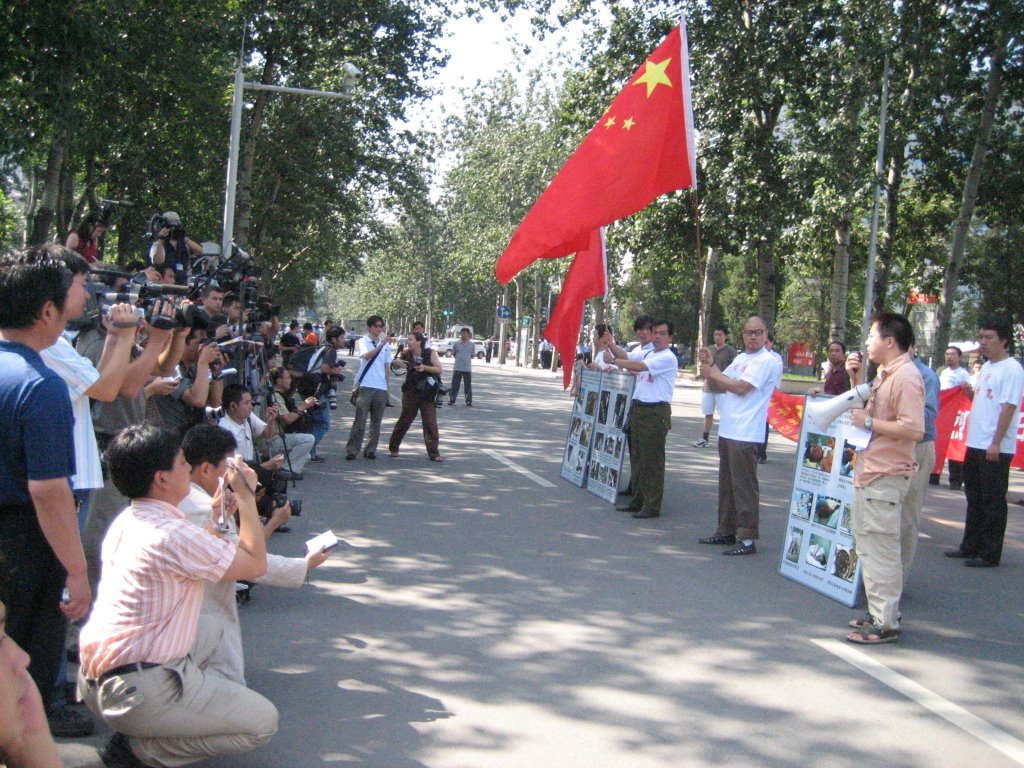
Unlike the anti-Japan riots of April 2005, journalists outnumbered demonstrators Tuesday as about 30 Chinese protested Japanese Prime Minister Junichiro Koizumi's visit to the Yasukuni shrine, which honors Japan's war dead, including 14 war criminals.

Friday, August 11, 2006


The lily pond and rose garden at Beijing's China Academy of Science Plant Research Institute are a brief respite from skyscrapers and smog.